
St. George (and the Dragon)
| Move further down the main aisle now, just beyond the central intersection. On the opposite wall, shown inside a thick cable surround is the remains of a painting of Saint George disposing of a dragon. This was painted at around the same time as St. Christopher, – around 1380 – and is part of the second layer. Legend has it that Sir George (as he would then have been known) was on his way to the Crusades. He arrived at a village to find a young princess about to be sacrificed to a local marauding dragon. True to form, Sir George snatched up the princess on to his horse in the nick of time, and promptly slew the dragon. | 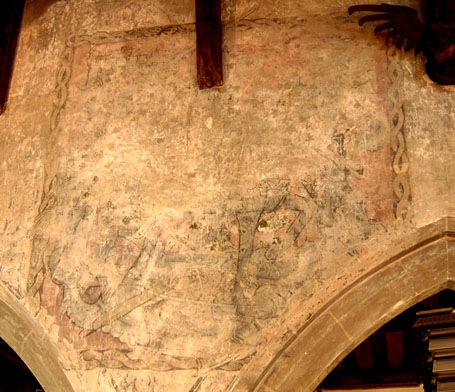 |
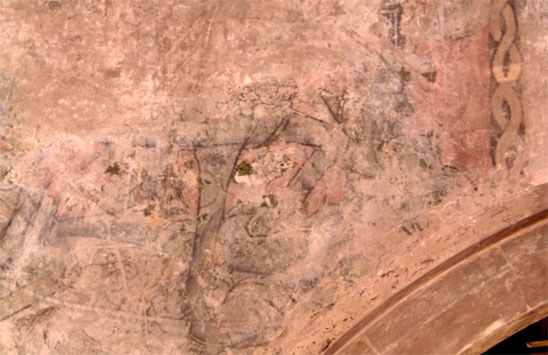
| You can still see the legs and tail of his horse, and if
you look very hard, you can make out the scaly tail and wings and body
of the dragon. All there is left of George to be seen now is his broken
lance and sword. As Saint George, he is now, of course, the patron saint
of |
 |
| The dragon is lying on its back - If you hard you might see the head of the dragon looking up. | 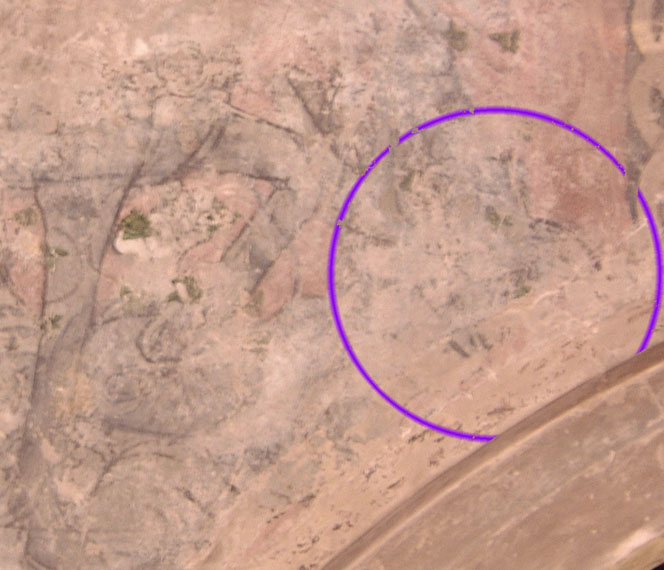 |
| NEXT |